
Building Better Elevators Starts with Building Them Better
In the elevator industry, quality and safety are often discussed as separate priorities. In reality, they are deeply connected. The way an elevator is designed, manufactured, and installed has a direct impact on jobsite safety, inspection readiness, project schedules, and long-term reliability. As construction projects continue to demand faster timelines and greater predictability, traditional field-built elevator systems are increasingly revealing their limitations.
The Resolute Elevator System was developed to address these challenges by fundamentally changing how elevators are delivered. Rather than assembling critical components piece-by-piece in the field, Resolute shifts the majority of construction, integration, and testing into a controlled factory environment. The result is a safer installation process, improved quality control, and a more predictable path from project kickoff to turnover.
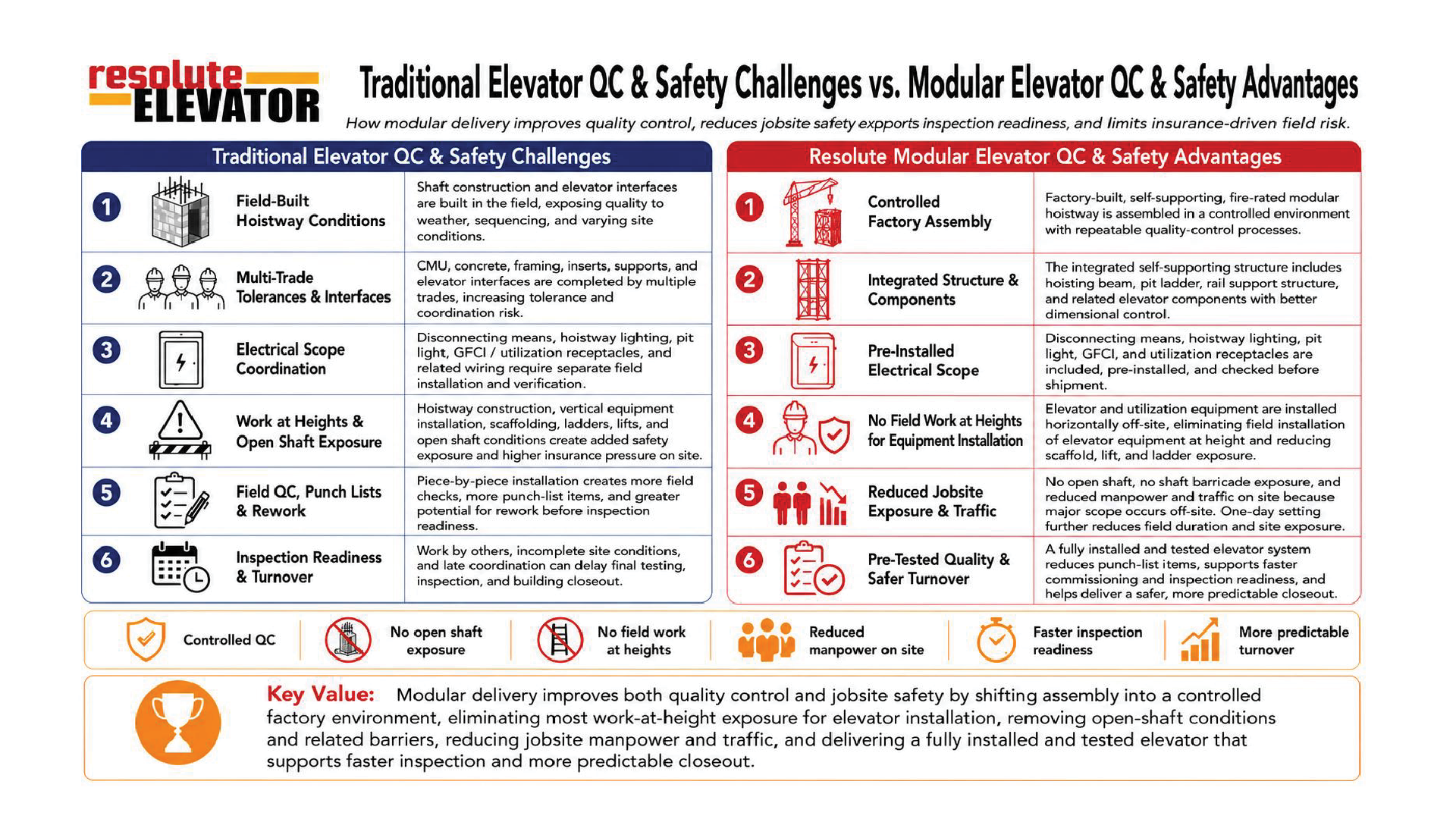
The Challenges of Traditional Elevator Construction
For decades, elevator installations have relied heavily on field-built hoistways and on-site coordination between multiple trades. While this approach is familiar, it introduces numerous variables that can affect both quality and safety.
Every project must contend with weather conditions, scheduling conflicts, varying site conditions, and coordination among concrete, masonry, steel, electrical, and elevator contractors. Each handoff creates opportunities for dimensional inconsistencies, tolerance issues, delays, and rework.
Electrical systems often require extensive field installation and verification. Equipment installation frequently takes place at significant heights within open elevator shafts, increasing exposure to safety risks and requiring additional scaffolding, lifts, ladders, and protective measures.
As a result, project teams often face more punch-list items, more field quality-control inspections, and greater uncertainty when preparing for final inspections and building turnover.
A Different Approach: Controlled Factory Assembly
The Resolute Elevator System takes a different path.
By manufacturing the hoistway and elevator structure as an integrated modular system, critical components are assembled in a controlled factory environment before they ever arrive on the jobsite. This controlled process allows for repeatable quality-control procedures, tighter dimensional accuracy, and comprehensive verification before shipment.
Instead of relying on multiple trades to create the elevator environment piece by piece, Resolute delivers an integrated solution where the structure, support systems, and elevator interfaces are already coordinated and assembled.
This approach dramatically reduces the variables that often impact traditional installations.
Improved Quality Through Integration
One of the greatest advantages of modular delivery is quality consistency.
Because the hoistway, support structures, and elevator interfaces are integrated during manufacturing, the system benefits from precise dimensional control that is difficult to achieve through traditional field construction. Components are assembled under controlled conditions using standardized processes and inspections.
Electrical elements such as disconnects, hoistway lighting, pit lighting, receptacles, and related systems can be pre-installed and verified before shipment. This significantly reduces the amount of field coordination required and helps eliminate many of the common installation issues that arise during construction.
The result is a more complete, tested, and inspection-ready elevator system.
Reducing Jobsite Safety Exposure
Safety is another area where the benefits of modular delivery become immediately apparent.
Traditional elevator installation often requires extensive work within open shafts and at significant elevations. Workers may spend substantial time installing rails, equipment, electrical components, and structural elements inside the hoistway.
With the Resolute Elevator System, much of this work is completed horizontally in a factory environment before delivery. By moving these activities off-site, exposure to fall hazards, open shafts, scaffolding, lifts, and ladder work is dramatically reduced.
The system also minimizes the number of workers and trades required on site during elevator installation, reducing overall jobsite traffic and lowering risk for everyone involved in the project.
Faster Inspection Readiness and Project Turnover
Project schedules are often impacted by late-stage coordination challenges. In traditional construction, incomplete site conditions, outstanding work by other trades, and unresolved punch-list items can delay testing, inspection, and occupancy.
Because the Resolute Elevator System arrives as a highly integrated and pre-tested solution, project teams can move more efficiently toward commissioning and final inspection. Reduced rework, fewer field adjustments, and streamlined installation contribute to faster inspection readiness and a more predictable turnover process.
For owners, developers, architects, and contractors, predictability is often just as valuable as speed. Knowing when a project will be completed—and having confidence in that schedule—can significantly improve project outcomes.
The Future of Elevator Delivery
The construction industry continues to embrace prefabrication and modular construction because they offer measurable improvements in quality, safety, and efficiency. Elevators should be no exception.
The Resolute Elevator System represents a modern approach to elevator delivery—one that reduces field risk, improves quality control, minimizes manpower requirements, and supports faster project completion. By shifting assembly into a controlled manufacturing environment, Resolute helps create safer jobsites, more reliable installations, and a better overall experience for owners and contractors alike.
As projects become more complex and expectations continue to rise, the future belongs to solutions that eliminate uncertainty rather than manage it. The Resolute Elevator System was designed to do exactly that: deliver a safer, smarter, and more predictable way to build elevators.
Recent Comments